Poon Hill with Muldai Peak trek
- Enjoy two beautiful sunrises at the foot of the Himalayas
- Head to the less crowded and more authentic Muldai viewpoint
- View of some magnificent snow-capped peaks: Annapurna South and Dhaulagiri
The Poon Hill trek with the addition of Muldai Peak is a perfect combination of nature, panoramic views, and authentic experiences. You are rewarded twice with a spectacular sunrise: at the popular Poon Hill and at the quieter Muldai viewpoint, which has not yet been discovered by the general public. Along the way, you hike through fairytale-like rhododendron forests and enjoy impressive vistas of snow-capped giants like Annapurna South and the mighty Dhaulagiri. An accessible yet unforgettable trek for nature lovers.
During this trek, you will have the opportunity to climb both Poon Hill and Muldai Peak at sunrise. Both locations offer breathtaking panoramas of the snow-capped peaks of the Himalayas. As the first rays of the sun slowly turn the white mountain peaks to gold, you will silently enjoy one of the most magical moments of your trip.

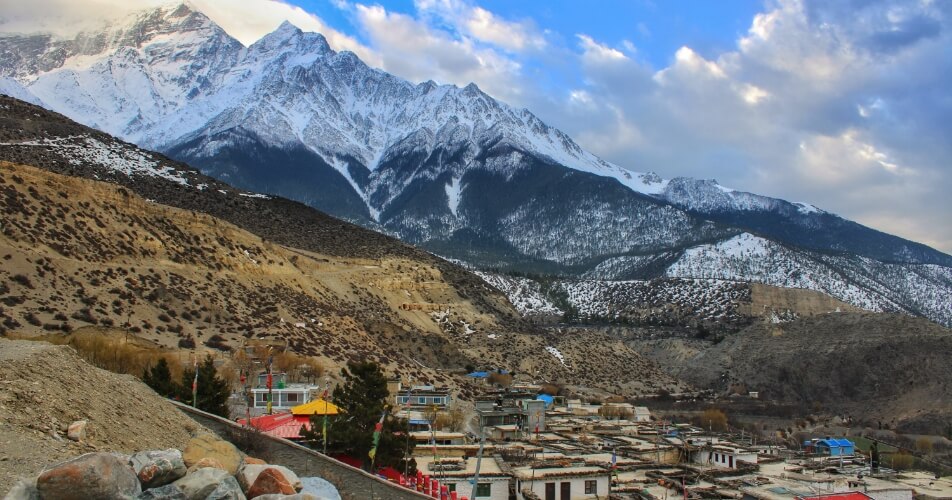
At various points during the trek, an impressive mountain landscape unfolds before you, featuring some of the highest peaks in the world. The mighty Dhaulagiri (8,167 m) and the elegant Annapurna South dominate the view and make every step on this route unforgettable.

While Poon Hill is well-known and frequently visited, Muldai Peak remains a hidden gem. Here, you can enjoy a view of the surrounding mountain giants in complete tranquility. Due to its remote location, this viewpoint is less touristy, making the experience feel all the more authentic.

A large part of this trek takes you through centuries-old rhododendron and oak forests. Especially in spring, the rhododendrons are in bloom, coloring the paths pink, red, and white. These stretches of forest offer not only shade and tranquility but also a chance to spot local flora and fauna, such as langurs and colorful birds.

This trek is ideal for those who want to get a taste of the beauty of the Himalayas in a short time. The program combines well-known highlights such as Poon Hill with the quieter Muldai viewpoint, allowing you to experience both the impressive vistas and the tranquility of less-trodden paths. Along the way, you will pass charming mountain villages and walk through beautiful forests full of rhododendrons. This trek is suitable for active families, travelers over 55, or anyone looking for a manageable yet impressive Himalayan experience.
Today you drive to Pokhara. You will stop at least once along the way, including at a fairytale-like spot next to the river for lunch.
You will arrive in Pokhara in the afternoon, where there is plenty to see and do. Pokhara is situated on the beautiful Lake Phewa. On a clear day, you can see the snow-capped peaks of the Annapurna range from here.
Take a beautiful walk along the riverbank and watch the locals fishing or repairing their boats. You can also take a small boat to the little island. Here, you can visit the Tal Barahi temple.


After a private car ride, you start your beautiful trek in the Annapurna. You begin in the village of Kimche.
Today offers a lovely mix of nature and culture. You will get to know the daily life of the local people. In some sections, you walk along terraced fields; in others, through forests with bamboo and past rhododendrons and oaks.
You walk partly along an unpaved road and then take the stairs up until you arrive in Ghandruk. In this picturesque Gurung village, you can enjoy a magnificent view of the Hiunchuli and the Machapucchre.
After lunch, you follow the path uphill past the traditional homes of Ghandruk and first climb to a teahouse with a beautiful view of the Annapurna. From here, you continue your way through a rhododendron forest until you reach Bhaisi Kharka.
A final short, steep climb takes you to Tadapani.


After breakfast, you leave the beaten paths and walk through a beautiful rhododendron forest in a more remote region. This less-trodden path leads you past several pristine Nepalese villages and stunning scenery.
After a short climb followed by a descent, you ascend almost the entire time. Along the way, you enjoy breathtaking views of the Annapurna South mountain range. You continue walking through the forest, which gradually changes into an oak and pine forest. Another half hour later, you arrive in Meshar Danda, where you have incredibly beautiful views from a ridge.
You continue walking along the path through the forest, and after passing an open slope, you climb further to a small pass where you also see a beautiful temple.
After the pass, you descend briefly through an open valley before re-entering the forest and walking on the ridge. You walk down again to a small river and then up again to Dobato.
If you wish and the weather is clear, you can walk another 45 minutes and go enjoy a sunset on Muldai Peak.


Today you are up early! After an early breakfast, you hike to Muldai Peak, where you enjoy a breathtaking sunrise over the snow-capped peaks of the Himalayas.
From Muldai, you hike along a steep path to Banthanti. This is a beautiful and remote part of the trek: you will encounter few to no other trekkers.
You hike along a steep path through a rhododendron forest to Deurali. After crossing a small pass, you descend to Ghorepani. Here you rejoin the main path and see quite a few other trekkers again.
Ghorepani was a popular stopping place for caravans heading to Tibet. From here, you have a view of the impressive Dhaulagiri (8,167 m)! Did you know that Dhaulagiri is the seventh highest mountain in the world?
Dhaulagiri (8,167 meters) is the seventh highest mountain in the world and was once the highest mountain known to the Western world.
Dhaulagiri was thought to be the highest mountain on Earth until 1848, before Kangchenjunga and later Mount Everest were charted. The name means “White Mountain” in Sanskrit, which is a perfect fit for the imposing, snow-capped peak that can be seen on many treks in the Annapurna region.


Today you are up early again. You leave your luggage at the lodge and climb for about 45 minutes to Poon Hill (3210 m) to admire the beautiful view of the Annapurnas and Dhaulagiri at sunrise.
After enjoying this, you walk back to Ghorepani, where you have breakfast.
Today you are mostly walking downhill: a long descent through beautiful rhododendron and oak forests takes you to Birethanti. You walk on to the village of Ulleri. Via a long, steep stone staircase, you eventually reach Hile.


Today, the path from Hile descends along the side of the valley. You walk along the bank of the Bhurungdi River. The path runs through bamboo forests, past a beautiful waterfall and a swimming pool.
You pass the last checkpoint and continue walking to the village of Birethanti (1000m). After Birethanti, you take a bridge and follow the eastern bank of the Modi Khola River. You cross the river again and follow the path uphill to Nayapul.
In Nayapul, you will be met by a private car that will take you back to Pokhara. You can spend the rest of the day at your leisure in Pokhara.


The end of your trip has arrived. Time to return to Kathmandu! You will make the return journey in a private car. You will stop at least twice again along the way. Next to the river, you can sample locally caught fish at a small local restaurant!


Accommodation during the trek
During the Poon Hill with Muldai Peak trek, you will stay in simple yet cozy teahouses or guesthouses run by local families. These accommodations offer an authentic experience of mountain life in Nepal. You will usually have a private room with two beds and a bathroom that is usually shared. A wood stove is often burning in the dining room, making it warm and cozy in the evenings. As you trek higher, the amenities become simpler, but the hospitality always remains heartwarming.
Accommodation in Pokhara
In Pokhara, you will stay in a comfortable, standard hotel close to the lively Lakeside area. Your room features a private bathroom, hot water, and often a balcony with a view of the garden or the lake. The hotel is quietly situated, yet within walking distance of restaurants and shops. After the trek, you can relax here and enjoy a refreshing shower, a good bed, and perhaps a massage or a drink on the terrace.
The price for this Poon Hill trek including Muldai Peak:
Adults: from € (to be confirmed) per person, based on two people
The Poon Hill trek, with an optional detour to the quieter Muldai Peak, is a short but highly varied trek through the Annapurna region, ideal for active travellers aged 55 and over and families with children aged 8 and above. You’ll walk through green valleys, traditional villages and rhododendron forests, with spectacular views of the Dhaulagiri and Annapurna mountain ranges along the way. Thanks to the gradual build-up of the walking route, the comfortable lodges and the option to plan the occasional rest day along the way, this trek is perfect for those who love nature, culture and a manageable physical challenge. Here we answer your most frequently asked questions about this accessible yet impressive Himalayan trek.
The Poon Hill trek with Muldai Peak is an easy to moderately challenging trek, with daily stages averaging 4 to 6 hours of hiking. There are stairs and occasional steep sections, but no technical passages. The altitude remains limited (max. approx. 3,637 m at Muldai Peak), keeping the risk of altitude sickness low.
No, this trek is suitable for beginners with a good basic level of fitness. Some hiking experience helps, but is not required. We do recommend practicing hill or stair climbing regularly beforehand.
Yes, families with children from about 8 years old can do this trek well, especially if they enjoy walking. The variety of nature, villages, and views keeps the trek interesting. However, children must be able to walk independently for a few hours a day.
You will stay in charming, simple lodges, often run by local families. Expect a comfortable bed, a hot meal, and usually a hot shower (for a fee). Bathrooms may be shared. Electricity and Wi-Fi are available at most places, but are not always reliable.
The best months are October-November and March-April. The weather is clear and dry then, and the rhododendrons are in bloom (especially in the spring). The winter months are also possible, but cooler. During the summer months (June–September) it is the monsoon, so it is wet and foggy; however, the path is well-laid out and this trek is possible even during the monsoon.
The trek is led by a local, English-speaking guide who pays close attention to the pace and comfort of the group. Porters are also available to carry your luggage, so you only hike with a daypack.
Yes, for this trek you need an Annapurna Conservation Area Permit (ACAP) and a TIMS card. We will arrange these documents for you before the start of the trek.
In addition to the iconic sunrise view from Poon Hill (3,210 m), you can also enjoy the tranquility and panoramic vistas from Muldai Peak (3,637 m). The trails are less crowded than the classic Poon Hill route, and you pass through charming Gurung villages along the way.
Yes, this tour is flexibly adaptable. Those who walk a bit faster can shorten by a day; those who prefer a more leisurely pace can plan an extra night. This makes the route very suitable for travelers who value comfort and flexibility.
A good daypack, sturdy hiking boots, layered clothing (for colder mornings), a raincoat, and sun protection are essential. We provide you with a handy packing list in advance, tailored to the season of your trip.
Both viewpoints offer a spectacular panorama of the Himalayas, but there are clear differences:
Poon Hill (3,210 m) is the most famous viewpoint in the region. From here, you can see Dhaulagiri, Annapurna South, Machhapuchhre (Fishtail), and Nilgiri, among others. Because it is so popular, it can be crowded during the high season, especially at sunrise.
Muldai Peak (3,637 m) is situated somewhat higher and is much quieter. Here, you see not only the peaks visible from Poon Hill, but also additional peaks such as Annapurna I and Lamjung Himal. Because fewer people visit, the view here feels more intimate and authentic.
In short: Poon Hill is famous and lively, while Muldai Peak is quieter and offers an equally impressive, often even more expansive view. So, it is ideal to include both in the trek!

Lorem ipsum dolor sit amet, consetetur sadip scing elitr, sed diam nonumy eirmod tempor invidunt ut labore et dolore magna. Lorem ipsum dolor sit amet, consetetur sadip scing elitr.
View our trips Travel proposal