
Annapurna Sanctuary trek | Annapurna Base Camp | 12 days
- Hiking in the glacier basin of the Annapurna mountain range
- Breathtaking sunrise from Poon Hill
- Surrounded by snow-capped peaks at Annapurna Base Camp
Annapurna Sanctuary trek | Annapurna Base Camp | 12 days
12 days from n.t.b. p.p.
Reisvoorstel aanvragenHighlights
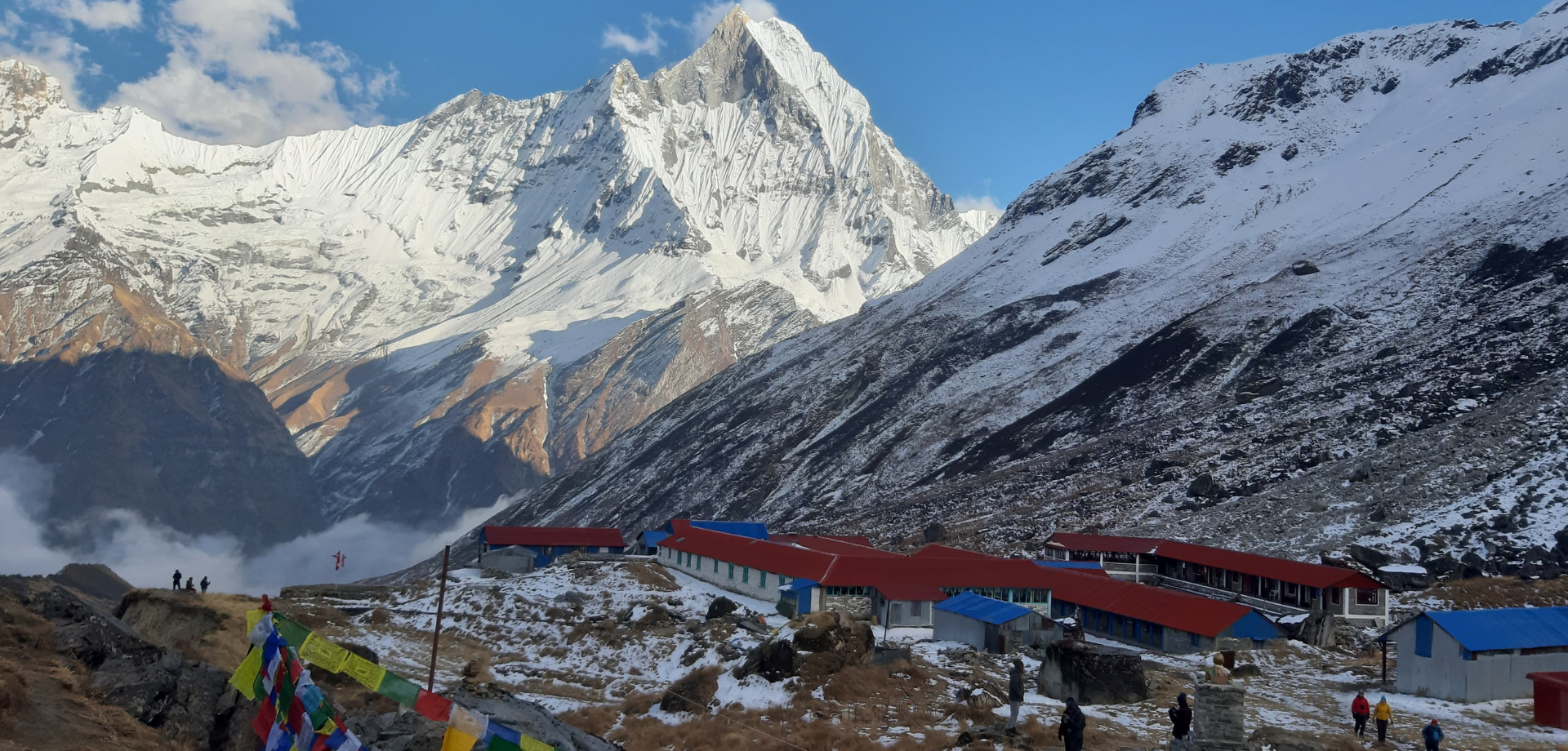
The Annapurna Sanctuary trek takes you deep into the heart of the Himalayas, into the impressive glacier basin of the Annapurna massif at an altitude of over 4,000 meters. An absolute highlight is the sunrise on Poon Hill, where you are rewarded with a panorama of golden mountain peaks. At Annapurna Base Camp, you are literally surrounded by giants like Annapurna I, Hiunchuli, and Machhapuchhare – an unforgettable experience. Along the way, you hike through an astonishingly varied landscape, from bamboo forests and lush jungles to rugged, open mountain plains. A classic trek of unparalleled beauty.
Walking in the glacial basin of the Annapurna mountain range
During this trek, you venture deep into the heart of the Himalayas. The Annapurna Sanctuary is an impressive natural amphitheater of glaciers and snow-capped peaks above 7,000 meters. At an altitude of over 4,000 meters, you experience the pure silence and grandeur of this magical place. The sense of smallness amidst so much natural power is one of the most memorable experiences of this trek.

Sunrise on Poon Hill
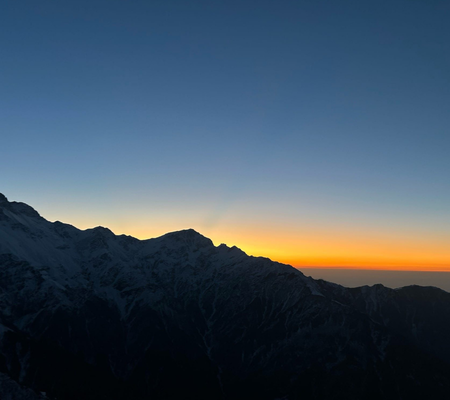
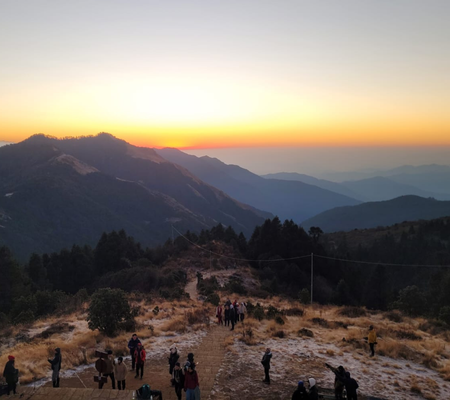
Early in the morning, you climb to the viewpoint at Poon Hill, where you are treated to a phenomenal sunrise. The first rays of the sun slowly color the mountain peaks of Dhaulagiri, Annapurna South, and Machhapuchhare golden yellow—a moment you will not soon forget. This is one of the most iconic views of Nepal and an absolute must during this trek.
Annapurna Base Camp: surrounded by mountain giants
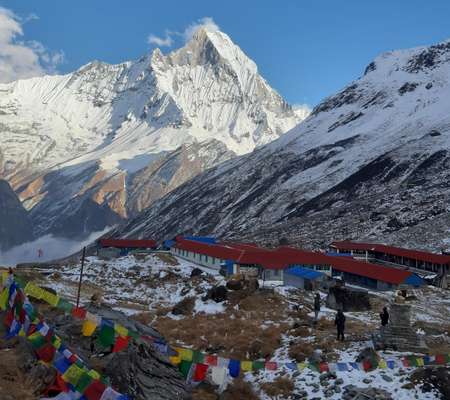
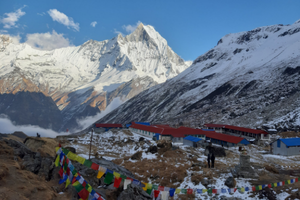
Reaching Annapurna Base Camp is the highlight of this trek – literally and figuratively. Here, at an altitude of 4,130 meters, you stand in the middle of an impressive circle of mountain giants. The silence, the fresh mountain air, and the view of peaks such as Annapurna I, Hiunchuli, and Machhapuchhare create a magical moment of wonder and satisfaction.
Walk through diverse landscapes
This trek offers an incredible variety of landscapes. In the lower regions, you hike through tropical jungles with bamboo, banana trees, and ferns. As you ascend, the landscape changes into alpine forests, rugged mountain flanks, and finally open glacier plains. This variety makes every hiking day unique and visually surprising.
Day-to-day
The Annapurna Sanctuary trek offers a unique opportunity to discover the heart of the Himalayas, with an impressive mix of breathtaking views, diverse landscapes, and cultural experiences. From the iconic sunrise at Poon Hill to the serene beauty of Annapurna Base Camp, every day on this trek will surprise you. Discover the varied nature, walk through villages, and experience the majestic views of the Annapurna and Dhaulagiri peaks. Follow our detailed day-to-day itinerary to make the most of your adventure in this impressive natural area.
-
Day 1: Scenic drive from Kathmandu to Pokhara
Today you drive along the only highway in the country to Pokhara. A highway in Nepalese terms is a winding single-lane road with plenty to see along the way! You will also stop several times en route: you will have lunch at an idyllic spot by the river!
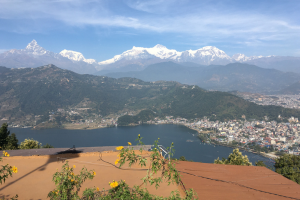
In the afternoon, you arrive in Pokhara, situated along the beautiful Lake Phewa. On a clear day, you can see the snow-capped peaks of the Annapurna range from here!
Take a beautiful walk along the riverbank and watch the locals fishing or repairing their boats. Or take a small boat to the little island and visit the Tal Barahi temple.In the evening, on the banks of Phewa Lake, at the temple, you can observe an Aarti ceremony: Hindu priests perform a ritual in which light (flames) are offered to the deities.

-
Day 2: Drive to Nayapul (approx. 1.5 hours) - Trek to Banthanti (2270m) - approx. 6 hours
You start your Annapurna Sanctuary trek in Nayapul, after a private car ride along winding roads.
The path leads down to the Modi Khola River, which you cross. You walk along the bank until you reach another bridge that takes you to the village of Birethanti (1000m).
Here you enter the Annapurna Conservation Area! After your documents have been checked, you continue following the path through bamboo forests, past a beautiful waterfall and a swimming pool. You walk along the bank of the Bhurungdi River. Afterwards, the path gradually climbs the side of the valley to Hile (1510m) and then passes Tirkedunga (1480m).
You cross the river via a suspension bridge and descend further to a large bridge that takes you over the Bhurungdi River. The path then climbs steeply up stone steps. Along the way, you have a magnificent view of the peaks of Annapurna South and Hiunchuli. The stone path continues to ascend to the Magar village of Ulleri (2080m).
You climb further along fields and dense forests until the path takes you to Banthanti. -
Day 3: Trekking to Ghorepani (2850m) - approx. 4 hours
After Banthanti, you trek through a densely forested area full of oaks and rhododendrons and cross many small rivers with clear mountain water. After a strenuous climb, you arrive in Nangathanti (2460m).
Ghorepani is another hour’s drive. Via a path with many steps, you slowly ascend towards Ghorepani. Today, the landscape changes into a densely forested area, filled in spring with blooming rhododendrons in various shades of red.
In Ghorepani, weather permitting, you can enjoy a magnificent view of the Dhaulagiri range, including Annapurna South and Annapurna I. -
Day 4: Sunrise at Poon Hill (3195m)/ Trekking to Tadapani (2721m) - approx. 5 to 6 hours
You depart while it is still dark and hike to Poon Hill (3195m). Here, weather permitting, you can enjoy a beautiful sunrise! The spectacular panoramic view of the Annapurna range and the Dhaulagiri peaks makes getting up early worthwhile. After sunrise, you return to Ghorepani for a well-deserved breakfast.
After breakfast, you continue hiking to Tadapani. The path first ascends through the forests, but then you will descend steeply to the village of Banthanti, where you will have lunch. This is a different village than the one you encountered earlier in your trek.
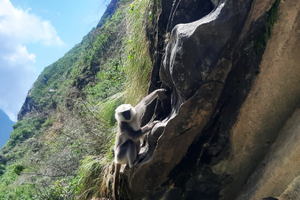
The path continues downhill along the vertical mountain walls until it reaches the headwaters of the Bhurungdi River. After crossing a wooden bridge, a short but steep climb to Tadapani follows. Large colonies of monkeys live in this forest area, and with a bit of luck, you will see them jumping around in the trees. It is approximately a two-hour hike from Banthanti to Tadapani.
Tadapani is an attractive village overlooking the Modi River valley. From here, in good weather, you have a beautiful view of the sacred Machapuchare mountain (Fishtail mountain). -
Day 5: Trekking to Chhomrong (2210 m) - 5 to 6 hours
Your trek starts today via a narrow path through the woods to a vast grassland. You pass Chiule and descend further via steep steps to Siprung. About ten minutes later, you arrive at a suspension bridge over the Khumna Khola River (1930m). In the past hour and a half, you have descended nearly 800 meters!
After the river, you ascend to the village of Ghurjung (2010m). The path leads you across various properties until you reach a wooden bridge. You cross the bridge and walk through a number of side valleys.
You climb steeply up to a mountain ridge, from where you have a magnificent view of Machhapuchhare (Fish Tail Mountain). You continue walking and pass the village of Taglu. A little further on lies the village of Chhomrong. -
Day 6: Trekking to Bamboo (2310m) - 7 to 8 hours
You first climb for about an hour to Kimrungdanda. Along the way, you enjoy beautiful views of Annapurna South, Hiunchuli, Fishtail Mountain (Machhapuchhre), and Ganggapurna. A steep descent then brings us to the Kimrong River.
After a steep climb from the Kimrong River to Chere Danda, you descend for a while, and then it is a pleasant walk to Bamboo. You descend via stone steps until you cross a bridge. From here, it is a strenuous climb to Sinuwa. Next, we walk through a beautiful forest to Kuldihar, followed by a short descent to Bamboo. -
Day 7: Trekking to Deurali (3140m) - 5 to 6 hours
You walk through a bamboo forest and slowly ascend a few steeper sections. Occasionally, the path descends briefly to cross a small river, but today you will mostly be climbing. Look into the treetops as well: this is the habitat of colonies of Langur monkeys!
After the village of Doban (2500m), you cross a river and then climb past the remains of an old landslide. You pass a small Shiva temple and then reach the Himalaya Hotel (2840m).
A rocky path through the forest transitions into a steep gorge through a dry forest until you reach the Hinku Cave.
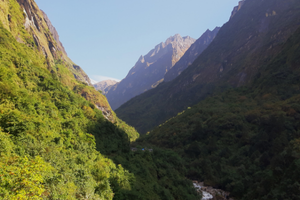
From here, the path slowly descends to the river over the remains of a glacier. Afterwards, you climb again to Deurali (3140m). This is by far the most beautiful part of your trek today! The view of the valley is breathtaking: the cascading river below with the steep rock faces beside it. -
Day 8: Trekking to Machhapuchhare Base Camp (3700m) - 3 to 4 hours
Above Deurali, the valley becomes much less steep and more expansive. Here, you truly feel the presence of the Himalayas! The path continues along the eastern side of the valley and climbs through a bamboo and birch forest. After crossing a river, you arrive in the village of Bagar.
You trek further uphill along stone paths, remnants of avalanches. You walk through a sparse birch forest and subsequently descend to a river. You eventually climb to Machhapuchhare Base Camp (3700m).
Machhapuchhare is a sacred mountain in Nepal. Climbing it is not permitted. The view of the Himalayas is breathtaking: you see Annapurna South, Annapurna I, Annapurna III, Hiunchuli, Gangapurna, and, of course, Machhapuchhare. -
Day 9: Trekking via Annapurna Base Camp to Bamboo (2310m) - 7 to 8 hours
Today you depart early in the morning for the sunrise to Annapurna Base Camp. This pleasant trek takes you to Annapurna Base Camp (4130m) in less than 2 hours. It is cold and windy there, but the view makes up for it and is breathtaking! This is one of the highlights of your trekking! In addition to an excellent view of the south flank of Annapurna, you also have a spectacular view of the glacier from the moraine!
The return hike is much easier. You hike back to Machhapuchhare Base Camp, then descend further to the Himalayan Hotel and finally go via Doban to Bamboo.Note on overnight stays in Annapurna Base Camp
In our program we have chosen not to stay overnight at Annapurna Base Camp, so that you do not sleep at the high altitude of over 4000 meters. This reduces the chance of symptoms of altitude sickness, which is especially important for families with children and older travelers. You will visit Annapurna Base Camp during the trek, so that you can enjoy the breathtaking views, but you will stay overnight in a lower area, where the conditions are more comfortable and the altitude does not pose an additional burden. If you prefer to stay overnight at Annapurna Base Camp, we can adjust this for you. -
Day 10: Trekking to Jhinu Danda (1780m) - 6 to 7 hours
You continue your descent today. This time, you walk down the steep stairs. You hike through beautiful rhododendron forests again to Sinuwa. Afterwards, the path continues downhill until you reach the river. On the other side, you climb continuously until you reach Chhomrong (2210m).
From Chhomrong, you descend again until you arrive in Jhinu Danda after just under an hour.
After today’s trek, you can take a wonderfully relaxing bath in one of the natural hot springs in Jhinu Danda (1780m). This is a lovely way to end the last day in the mountains!Idllically nestled along the banks of the Modi Khola River, Jhinu Danda Hot Springs are fed by natural geothermal activity.
Tip:
Pack a small towel and flip-flops in your daypack if you plan to visit the hot springs. The hike to the springs from Jhinu Danda is about 15-20 minutes downhill, and wet feet or soaking wet clothes can be uncomfortable on the way back. It’s best to go in the late afternoon for an extra relaxing end to your day of trekking. -
Day 11: Trekking to Syauli Bazaar - approx. 4 hours / Drive to Pokhara (approx. 2 hours)
After breakfast, you start the final part of your trek. The path takes you downhill along the western bank of the Modi Khola. You cross the river and continue following the path up and down until you reach a new bridge (1500m). Along the way, you have beautiful views of the Modi Khola valley.
You continue walking to Syauli Bazaar, where your trek ends! Here, you will be met by your driver who will take you back to Pokhara!
You can spend the rest of the day at your leisure in Pokhara. -
Day 12: Drive to Kathmandu (205km) - approx. 7 to 8 hours
The end of the journey has arrived! From there, your private driver will take you back to Kathmandu! You will stop a few times along the way to briefly stretch your legs. You will also stop for lunch: here you can also sample the local fish from the river!









Overnight stays
Accommodation during the Annapurna Sanctuary Trek
The teahouses along the Annapurna Sanctuary trek offer simple but comfortable overnight options. Since you are hiking in the heart of the Himalayas, facilities vary depending on altitude and location. In the lower parts of the trek, such as in the villages of Ghorepani and Tadapani, the teahouses are well-equipped with hot meals, clean beds, and basic facilities. As you ascend, the teahouses become more basic, but they still offer a welcoming atmosphere with a roof over your head and the opportunity to warm yourself by a fireplace or wood stove. Keep in mind that it can be colder in the mountains, and warm clothing is recommended, especially during the nights. The teahouses are also a great place to experience local Sherpa culture.
Standard Hotel in Pokhara
At the end of your trek in Pokhara, you will stay in a comfortable standard hotel. These hotels offer all necessary facilities, such as hot showers, free Wi-Fi, and a restaurant where you can enjoy local and international dishes. Pokhara is a popular destination for trekkers, so the hotels in this city offer a relaxed atmosphere to recover after your adventure in the mountains. The hotel is often located near the lake, providing a peaceful environment and beautiful views, ideal for enjoying the surroundings and relaxing after your trek.

Price Information
The price for this Annapurna Sanctuary trek:
Adults: from € (to be confirmed) per person, based on two people
Want to tailor your own Nepal trek?
There are various options available for this trek; you can adapt it to suit your preferences!
Inclusief
- Private car ride from Kathmandu to Pokhara
- Briefing with the guide for the trek
- 2 nights in a standard hotel in Pokhara
- Transfer from Pokhara to starting point Nayapul
- 9 nights in standard teahouses along the trails
- 9x breakfast, 9x lunch, 9x dinner
- English-speaking guide (his salary, insurance, meals, accommodation, and transport)
- Luggage porter - 1 porter per 2 people - max. 18 kg (includes wages, insurance, meals, accommodation, and transport)
- Required documents for the trek
- Transfer from ending point Syauli Bazaar to Pokhara
- Transfer by private car from Pokhara to Kathmandu
Exclusief
- Entrance fees and donations at cultural sites
- Stay in Kathmandu
- Tip for guide, porter, and driver
- Personal expenses (snacks, WIFI, warm water during trek,...)
- Drainks and desserts
- Lunch and dinner en route and in Pokhara
- Visa for Nepal
- International flight tickets
- Travel and cancellation insurance
- Everything not explicitly stated as included
Practical
The Annapurna Sanctuary trek (also known as the Annapurna Base Camp trek) is an iconic hike that takes you deep into the heart of the Annapurna massif. This impressive trek leads you through lush valleys, traditional Gurung villages, rhododendron forests, and ultimately to the impressive amphitheater of mountains, surrounded by giants such as Annapurna I (8,091 m) and Machapuchare. Thanks to the good infrastructure, comfortable lodges, and gradual increase in altitude, this trek is highly suitable for active travelers over 55 and adventurous families with older children. On this page, we answer the most frequently asked questions about this trek so that you are well prepared before setting off.
-
How difficult is the Annapurna Sanctuary trek?
The trek is moderately difficult and manageable for active travelers with a good basic level of fitness. The paths are clear and not technical, but there are several days with significant ascents and descents. Good preparation, such as hiking with a daypack in hilly terrain, is recommended.
-
What is the best time to travel for the Annapurna Sanctuary trek?
The ideal seasons are spring (March-May) and autumn (October-November). The weather is usually clear then, the views are spectacular, and the rhododendrons bloom in the spring. Winter is quieter, but colder, especially at night.
-
Do I need to have experience with multi-day treks?
Experience is a plus, but certainly not a requirement. Many of our participants are over 55 who enjoy hiking and are looking for a unique nature experience. A local guide provides guidance and ensures safety.
-
What kind of accommodations are available during the Annapurna Sanctuary trek?
You will stay in simple but comfortable lodges (“tea houses”) with a hot meal and a bed with a mattress and blankets. Bathrooms may be shared. Some lodges have hot showers and Wi-Fi, although this is not always guaranteed.
-
Is there Wi-Fi or mobile coverage during the Annapurna Sanctuary trek?
In the lower-lying villages, there is often mobile coverage and sometimes Wi-Fi (for a fee). The higher you go, the more limited the connection becomes. Do not expect a constant connection – think of it as a digital detox.
-
What should I bring on this Annapurna Sanctuary trek?
We will provide you with a detailed packing list in advance. Essential items include: sturdy hiking boots, warm clothing, a raincoat, a daypack, sun protection, and a reusable water bottle. During the trek, your main luggage will be carried by a porter.
-
What about altitude sickness?
The Annapurna Sanctuary trek gradually builds up altitude, which limits the risk of altitude sickness. The maximum altitude is approximately 4,130 meters. We allow sufficient time to acclimatize, and our guides are trained to recognize symptoms early.
-
Is this a suitable trek for a family with teenagers?
Absolutely! Teenagers in good physical condition and with a sense of adventure will find this an unforgettable experience. The variety of landscapes and the challenge make this trek particularly engaging for young people aged 12 and up.
-
How does this trip help support local communities?
By hiking with a local guide and using Nepalese lodges and porters, you contribute directly to the income of the local population. We pay fair wages to our employees and work sustainably.
-
Why don't we stay overnight at Annapurna Base Camp itself?
Although Annapurna Base Camp (ABC) is the absolute highlight of the trek, we deliberately do not spend the night at this altitude (4,130 meters) on our trips. There are two important reasons for this:
1. Health and safety: Staying overnight at high altitude increases the risk of altitude sickness, especially since ABC is reached fairly quickly after Machapuchare Base Camp. By visiting Base Camp only as a day trip and then descending to a lower lodge, we significantly limit this risk.
2. Comfort and a good night’s sleep: The lodges in ABC are simple and often cold, especially during the seasons outside of summer. At lower altitudes (for example, in Machapuchare Base Camp or Deurali), staying overnight is more pleasant and you sleep more soundly.
This way, you can fully enjoy the spectacular views at Base Camp — with enough time to look around and take photos — without the downsides of a night at this altitude.

Trekking in Nepal with guides who truly care about you
Our guide Chhoisang Lama and sherpa Gaknaht were wonderful people. Perfect guides for anyone looking to trek in Nepal.

- Mardi Himal trek
- April 2025
Reliable family business with an eye for detail: our beautiful Langtang experience
I highly recommend Nepal Inside Out. It is a family business with a long history of experience in travel and trekking across the region.
- Roundtrip with Langtang trekking
- April 2025
Travel safely and well cared for through Nepal thanks to a fantastic team
We always felt safe and well looked after.
- Roundtrip with Lower Annapurna trek
- March 2025
An unforgettable family trip with trekking in Nepal during the Easter holidays
We were also so glad to have made this trip as a whole family and to witness the interactions between the local people and our children.
- Family trrip with 4-days trekking
- April 2024
Nepal with the family? This trip exceeded all our expectations!
Many thanks to the wonderful team at Nepal Inside Out! They went above and beyond to organise our trip through Nepal with great care. The Langtang trek was beautiful, and we were accompanied by a kind guide and two brilliant porters who helped us enormously.
- Roundtrip with Tamang / Langtang valley trekking
Discover beautiful Nepal with Nepal Inside Out.
From breathtaking views to beautiful trails and warm evenings together. Nothing is too much trouble, and every effort is made to make the trip truly memorable. Many thanks and highly recommended for anyone wanting to discover Nepal with Nepal Inside Out.
- Roundtrip with Mardi Himal trekking
- November 2024
Perfect 3-week tour through Nepal
Maaike and Chuda put together the perfect three-week trip through Nepal for us, including adventurous treks with stunning views, cultural visits with knowledgeable guides, and truly enriching encounters with local Nepali communities. The whole team is well organised and made up of genuinely dedicated people who act quickly whenever something is needed or something has not gone to plan. Highly recommended for anyone looking to book a trip to Nepal.
- Roundtrip with Mardi Himal trekking
- October 2023
Excited about Nepal?
Lorem ipsum dolor sit amet, consetetur sadip scing elitr, sed diam nonumy eirmod tempor invidunt ut labore et dolore magna. Lorem ipsum dolor sit amet, consetetur sadip scing elitr.
View our trips Travel proposal