
Langtang Trek | 9 days
- Hike through the picturesque Langtang Valley with impressive mountain panoramas
- Visit the traditional Tamang village of Kyanjin Gompa (3,860 m)
- Optional climb to Kyanjin Ri or Tsergo Ri for panoramic views
Langtang Trek | 9 days
9 days from n.t.b. p.p.
Reisvoorstel aanvragenHighlights
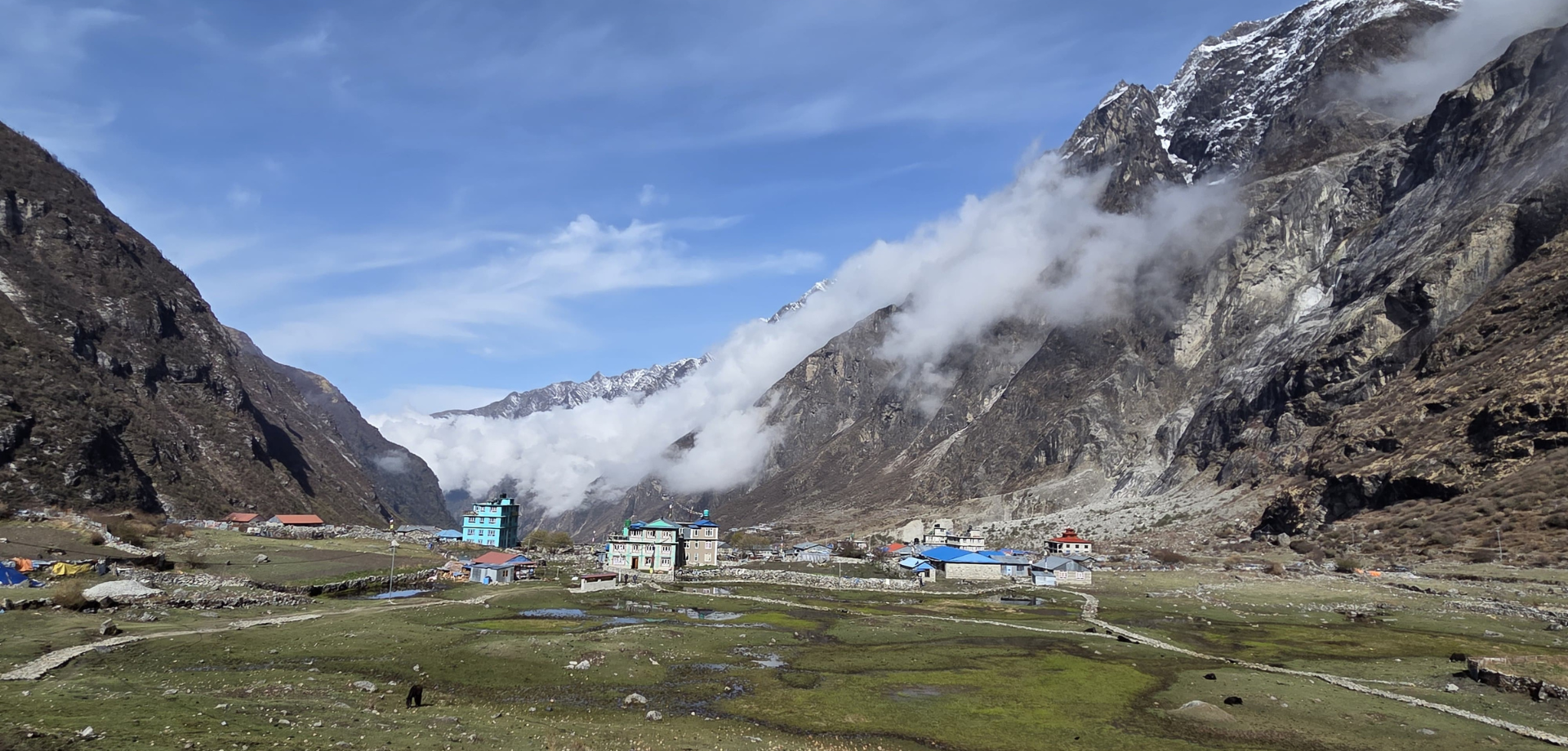
During this trek, you will hike through the impressive Langtang Valley, a region known for its varied landscapes, traditional mountain villages, and spectacular views of the Himalayas. You will explore a less touristy area with a rich culture, where you will meet the hospitable Tamang and Sherpa people. From the charming mountain village of Kyanjin Gompa, you can optionally admire the views from Kyanjin Ri or Tsergo Ri — both offering breathtaking panoramic vistas. This trek combines nature, adventure, and culture into a well-balanced trekking experience, ideal for those seeking an authentic piece of Nepal.
Walk through the picturesque Langtang Valley with impressive mountain panoramas
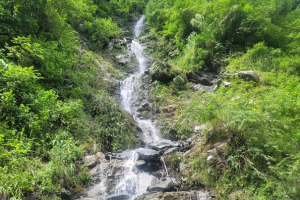
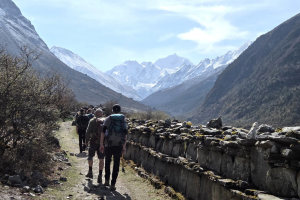
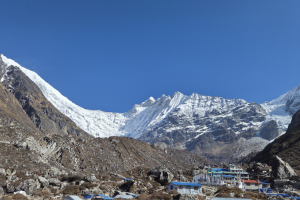
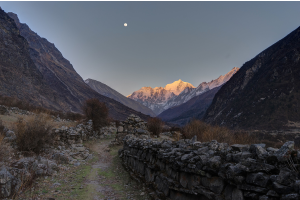
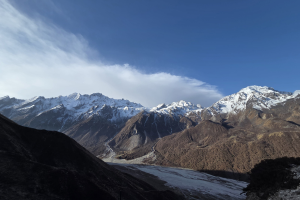
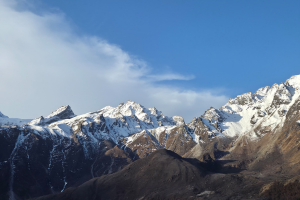
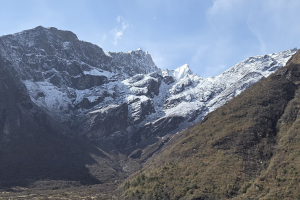
The Langtang Valley offers a unique backdrop of imposing mountain peaks, vast glaciers, and dense forests. During the trek, you are surrounded by the peaks of Langtang Lirung (7,227 m), Dorje Lakpa, and Ganchenpo, which tower over the valley like sentinels. The landscape changes constantly—from subtropical forests full of rhododendrons and bamboo to alpine meadows and rugged glacier plains. This makes every hiking day special and photogenic. Especially in the upper part of the valley, around Kyanjin Gompa, the landscape unfolds in full glory.

Visit the traditional Tamang village Kyanjin Gompa (3860 m)
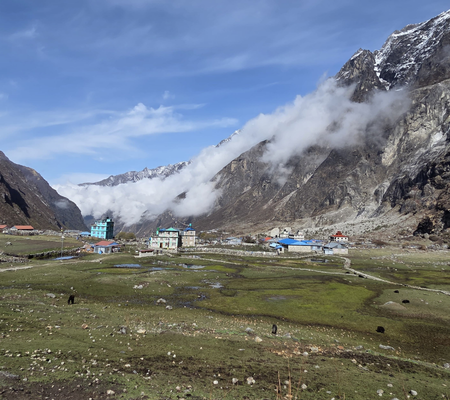
The village of Kyanjin Gompa, situated at an altitude of approximately 3,870 meters, lies beautifully nestled among the mountains. It is not only a spiritual center with a Buddhist monastery but also the base for panoramic hikes to Kyanjin Ri or Tsergo Ri. From these viewpoints, you have a breathtaking 360° view of the surrounding glaciers and Himalayan giants. In the village itself, you can visit a local cheese dairy, which provides an unexpected and tasty treat for many hikers at high altitude.
Optional climb to Kyanjin Ri or Tsergo Ri for a panoramic view
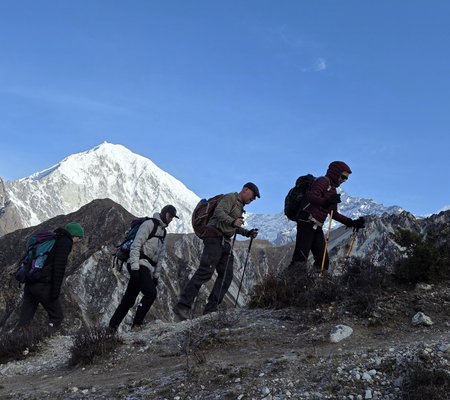
For those seeking an extra challenge, a climb to one of the viewpoints around Kyanjin Gompa is highly recommended. You can choose between Kyanjin Ri (approx. 4,600 m) or the higher and more strenuous Tsergo Ri (approx. 5,000 m). These peaks offer some of the most beautiful views in the region: a panoramic view of Langtang Lirung, Langshisa Ri, Yala Peak, and even the Tibetan border. The climb is tough due to the altitude, but those who leave early and take their time will be amply rewarded. It is an experience you won’t soon forget—standing in silence among the giants of the Himalayas, high above the valley.
Get acquainted with the local Tamang and Sherpa culture in an authentic setting
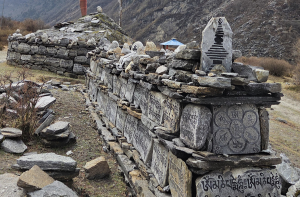
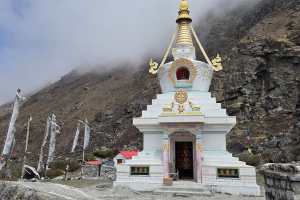
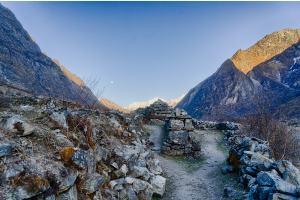
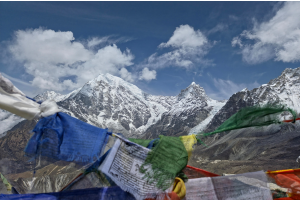
The Langtang Valley is inhabited primarily by Tamang and Tibetan communities, whose culture is deeply rooted in Buddhism. Along the trail, you will pass colorful prayer flags, mani walls, and stupas that bear witness to this spiritual tradition. During the trek, you will stay in small-scale, family-run lodges where hospitality and simplicity take center stage. What makes this route extra special is the tranquility: instead of busy trails full of tourists, you will walk here among local shepherds, villagers, and yak caravans. The villages along the way offer a unique opportunity to experience traditional mountain life up close. Since the 2015 earthquake, the area has been slowly rebuilt, and your visit contributes to sustainable tourism and the reconstruction of these resilient communities.
Day-to-day
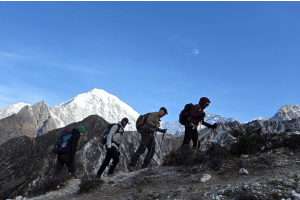
This Langtang trek through the Langtang Valley is perfect for travelers who want to discover the beauty of the Himalayas without the extreme crowds or physical challenge of more strenuous treks. You hike at your own pace along well-maintained paths, through forests, alongside glacial rivers, and towards impressive mountain panoramas. Along the way, you stay in welcoming lodges and experience the rich culture of the Tamang people. Altitude is built up gradually, and rest days or shorter stages are possible. Ideal for those who like to stay active and appreciate comfort while traveling.
-
Day 1: Adventurous ride to Syabrubesi (1503m) by jeep
Today you depart for a road trip to the starting point of your trekking in Syabrubesi.
You drive up along the mountain ridges as you leave the Kathmandu Valley. You have a magnificent view of the Annapurna range to the west, but you also see Manaslu, the Ganesh Himal, and, of course, the snow-capped peaks of the Langtang Mountains. Along the way, you see beautiful scenery: rivers, slopes full of terraced fields, and picturesque villages.
Before reaching Dunche, you drive through the lively town of Trisuli. You continue on to Syabrubesi, where you will spend the night.Travel time: approx. 7 to 8 hours
Distance: approx. 112 km
-
Day 2: Trek to Lama Hotel (2,470 m)
After breakfast in Syabrubesi, your trek begins along the Bhote Kosi River, which flows down through the Himalayas from nearby Tibet.
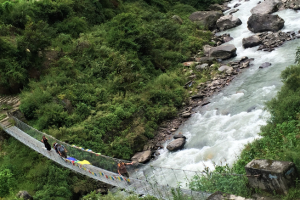
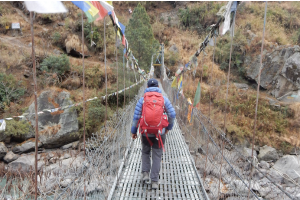
You first follow the paved main road. After crossing a suspension bridge over the Langtang River, you walk through subtropical forests and then climb the path through oak and rhododendron forests. Be sure to keep a close eye out in the trees for langurs, as well as unique wildlife such as martens and wild boars. If you are lucky, you might catch a glimpse of the rare red panda.
The path to the Lama Hotel is steep at first, but then ascends more gradually until you reach the Lama Hotel.Walking time: approx. 5–6 hours
Distance: approx. 10 km -
Day 3: Trekking to Langtang village (3430m)
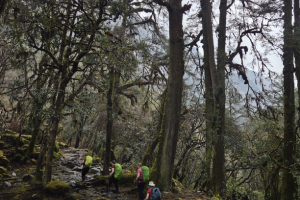
Today, your day starts with a climb through a forest: it sometimes resembles a semi-jungle, with ferns and orchids growing on the trees. Occasionally, the Langtang Lirung peaks peek out from between the trees! At Ghora Tabela, you leave the forest and can enjoy beautiful snow-capped peaks on both sides of the valley.
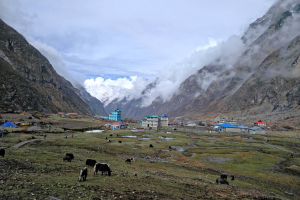
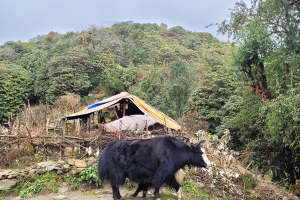
You continue climbing gently upwards, and the valley widens. You pass several temporary settlements: this is where the shepherds stay who graze their herds on the green alpine meadows during the summer. There is a good chance you will see yaks here!
Finally, you hike on to the Langtang Valley, where the village of Langtang is located. Both Tamangs and Tibetans live here.
The old village of Langtang was completely wiped off the map by the 2015 earthquake. Since then, the village has been rebuilt 100 meters above the ruins of the old one. This new location is safer than the old one. It is still situated close to cliffs, but vertical cliffs are less susceptible to avalanches.
You spend the night in one of the newly built teahouses and, in this way, help the local population recoup their investments of the past few years.Walking time: approx. 5–6 hours
Distance: approx. 11 km -
Day 4: Trekking to Kyanjin Gompa (3870m)
After a half-hour walk, you first reach the village of Mundu. From there, you gradually climb upwards through green yak pastures. It is remarkable how vast the view is here in the valley, right in the middle of the mountains!
After crossing several small streams and moraines, you arrive in Kyanjin. In this settlement, there is not only a small Tibetan monastery, but you will also find a cheese factory! There is no better place to eat and drink!
In the afternoon, you have time to relax: take a look around the village or explore the neighborhood. If you still have enough energy, walk to Langshisha Kharka and enjoy a breathtaking view there.Walking time: approx. 3–4 hours
Distance: approx. 6–7 km -
Day 5: Rest day in Kyanjin Gompa - Hike to Kyanjin Ri or Tsergo Ri
Today is a rest day, so you have time to rest and relax. If you took it easy yesterday, you can visit the monastery or the cheese factory today. If you are feeling completely fit, you can walk on the moraine to enjoy the magnificent view of the ice walls and glaciers of Langtang Lirung.
If you really want to hike today, head to Kyanjin Ri (4773m), directly behind the village. From this point, you have a 360-degree panoramic view of the beautiful Langtang Mountains with their snow-capped peaks. It is best to leave early for your hike to Kyanjin Ri: the views are clearest in the morning.
Another, more strenuous alternative is climbing to Tsergo Ri (4884m). From here, you have a spectacular view of Langtang Lirung, the Langtang Mountains, Kinshung, Yansa Tsenji, and the foot of the great Lirung Glacier. After lunch, you can then take a walk in the Kyanjin Valley. -
Day 6: Trekking to Lama Hotel
After breakfast, you start hiking. You follow the path you took previously: through the valley, you first follow the Langtang Khola River to Mundu, Langtang, and then Ghora Tabela.
You make faster progress than when climbing, and although the path is the same, the views are different. Take the time today to enjoy the lush green forests and the view of the snow-capped peaks of Langtang.
You have lunch along the way and continue following the path downhill until you return to Lama Hotel. This protected area is one of the most pristine valleys in Nepal.Walking time: approx. 6 hours
Distance: approx. 14 km -
Day 7: Trekking to Thulo Syabru (2230m)
After breakfast, you walk through a bamboo and rhododendron forest. If you are lucky, you may spot wild boars, monkeys, and other wildlife in these woods. You will also hear and see a wide variety of birds.
Along the way, you will enjoy a beautiful view of the Ganesh Himal and other mountains. After an easy descent along the riverbank, you ascend a steep section to the village of Thulo Syabru.Walking time: approx. 6 hours
Walking distance: approx. 10 km -
Day 8: Trekking to Dhunche (1960m)
Today is your final hiking day, during which you walk to the endpoint in Dhunche.
You walk from the village of Syabru past villages, through fields, and over a ridge, descending gradually. From the village of Brabel, you have a beautiful view of the Ganesh Himal.
You continue walking, and there is a steep descent along a stream and the mountainside, starting from the village of Braccaka. At the end of the descent, you cross a suspension bridge.
The trek ends by climbing uphill into the forest, away from the Trisuli River. Did you know that the water in this river comes from the sacred Lake of Gosainkund? You climb until you arrive in Dhunche.Walking time: approx. 5 hours
Walking distance: approx. 8 km -
Day 9: Return trip by jeep from Dhunche to Kathmandu
After breakfast, you will drive back to Kathmandu by private jeep. The journey takes approximately 6 to 7 hours. Along the way, you can enjoy the scenery one last time.
Travel time: approx. 6–7 hours
Distance: approx. 110 km


Overnight stays
During this trek, you will stay overnight in simple but charming lodges (teahouses) run by local families. Each lodge offers a warm welcome, often featuring a wood-burning stove in the common area where you can meet other hikers or unwind with a cup of hot tea.
The rooms are basic but comfortable: usually equipped with two single beds with mattresses, blankets, and a pillow. During the colder months, we recommend bringing your own sleeping bag for extra warmth. Sanitary facilities are shared and vary by lodge – sometimes a hot shower is available (for a small extra charge), sometimes only cold water.

Price Information
The price for this Langtang trek through the Langtang Valley is:
Adults: from € (to be confirmed) per person, for two participants
Inclusief
- Briefing with the guide for the trek
- Transfer by jeep from Kathmandu to Syabrubesi
- 8 nights in standard teahouses
- 8x breakfast, 8x lunch, 8x dinner
- English-speaking guide (his salary, insurance, meals, accommodation, and transport)
- Porter for your luggage - 1 porter per 2 people - max. 18 kg (includes wages, insurance, meals, accommodation, and transport)
- Required trekking documents
- Transfer by jeep from Dhunche to Kathmandu
Exclusief
- Entrance fees at cultural sites & donations
- Stay in Kathmandu
- Personal expenses (snacks, hot water for shower, WIFI,...)
- Drinks and desserts
- Tips for guide, porter and driver
- Visa for Nepal
- International flight tickets
- Travel and cancellation insurance
- Everything not explicitly mentioned under inclusive
Practical
The Langtang trek through the Langtang Valley is one of the most accessible and atmospheric treks in Nepal, making it particularly suitable for active travelers over 55 and families with children. You will hike through a picturesque valley past mountain slopes dotted with rhododendrons, bamboo forests, and authentic villages of the Tamang people. Along the way, you will enjoy impressive views of the snow-capped peaks of the Langtang range, including Langtang Lirung. This trek combines natural beauty with culture and is also slightly less crowded than the more well-known routes. On this page, you will find answers to the most frequently asked questions so that you can start your adventure well-prepared.
-
How difficult is the Langtang trek?
The Langtang Valley Trek is a moderately challenging trek, ideal for active over-55s and fit families. The daily walking time varies between 4 and 6 hours. The highest point is around 3,800 meters (Kyanjin Gompa), which makes this trek not too difficult technically, but a good basic level of fitness is important.
-
What is the best time to travel for this trek?
The best times to visit are spring and autumn: March to May and October to November. During these months, the weather is stable and clear, offering the best views of the mountains. In spring, the rhododendrons are in bloom.
-
Where do you sleep during the Langtang trek?
You will stay in simple but comfortable teahouses run by local families. The rooms are usually basic, with a bed and blanket; sometimes a private bathroom, but more often shared sanitary facilities. The common areas are cozy and heated.
-
How do you arrange the permits for this trek?
For this trek, you need a TIMS card and a Langtang National Park permit. These will be arranged for you in advance by us, so you don’t have to do anything yourself.
-
Is there mobile coverage or Wi-Fi on the way?
In the lower parts of the route there is sometimes mobile coverage, but higher up it is limited. Some lodges offer Wi-Fi for a fee, but it is not reliable everywhere. It is advisable to view this as a ‘digital detox’.
-
Do I have to carry my own luggage?
No, we will provide a porter who carries your luggage in a large waterproof duffel bag. You yourself will only carry a light daypack with water, snacks, sunscreen, and your camera.
-
Is there a risk of altitude sickness?
Although the highest point remains below 4,000 meters, there is always a small chance of altitude sickness. The build-up of this route is gradual and includes an acclimatization day in Kyanjin Gompa, which significantly reduces the risk.
-
Can I go on this trip with minor joint problems?
The paths are easy to walk on, but do include some changes in elevation and steps. Sturdy walking shoes, walking sticks and, if necessary, knee braces are strongly recommended. If you’re unsure, please feel free to consult us or your doctor.
-
Is this trek suitable for children?
Yes, children aged around 8 and over who are in good physical condition and up for an adventure will find this trek well within their capabilities. The route is safe, the daily distances are manageable, and there is plenty to discover along the way.
-
What makes this trek unique compared to other popular routes?
The Langtang Valley trek offers the perfect blend of nature, culture and mountain scenery, without the crowds found on the Everest or Annapurna treks. The Tamang culture, the views of the Langtang Himal, and the warm hospitality along the way make it a unique experience.
-
Can I combine the Langtang trek with other routes?
Yes, this trek can easily be combined with, for example, the Tamang Heritage trek or the Gosaikunda trek for those who wish to spend a little longer on the trail. We would be happy to put together a bespoke itinerary for you.
-
How safe is the Langtang trek?
The Langtang trek is considered a safe route, even for older travellers and families. You’ll be accompanied by an experienced local guide who knows the area well, knows what to do in an emergency, and will keep a close eye on your health at all times. The trails are well-marked, there are no technical sections, and you’ll spend each night in villages with basic facilities. Comprehensive travel insurance covering mountain trekking is essential.

Excited about Nepal?
Lorem ipsum dolor sit amet, consetetur sadip scing elitr, sed diam nonumy eirmod tempor invidunt ut labore et dolore magna. Lorem ipsum dolor sit amet, consetetur sadip scing elitr.
View our trips Travel proposal